Showing posts with label interview. Show all posts

Sunday, November 23, 2008

Western Fifth - CD review & interview


Listening to Western Fifth’s recent release Stand Like a Thief is a little like dancing that achingly fleeting slow dance with the girl (or guy, depending) that you almost but never quite asked out in high school. This is not to say by any means that the music itself evokes high school – it feels more like the late nights spent on porches across America at the end of a party where those remaining are a little too drunk to get home and so sit, smoke cigarettes and wait for sobriety or dawn, whichever comes first. Add those two (somewhat disparate) elements together and you’ll get a basic approximation of this encompassing and enjoyable debut offering.

When put onto I-Tunes, the Genre listed is “Country,” which lead me to wonder who makes the determination of the genre. Does the band get to decide what their genre is? If asked to pick a genre for Western Fifth, I’d probably offer up some strange hybrid like post-country shoe-gaze indie rock, which doesn’t fit in the genre box on I-Tunes, so it’s probably best that no one asked me. The band has an interesting and rewarding way of reminding the listener of a different band with every listening. Upon repeat visits, I have uncovered sounds and songs influenced or reminiscent of Wilco, The Walkmen (see below for why this isn’t an influence), Okkervil River, and surprisingly upon my most recent listen – a dose of early Jakob Dylan and the Wallflowers. Listen to the burst of organ on the their third track “In the End I Went Away” and see if you can disagree.

Cake in 15 was lucky enough to secure an exclusive email interview with Western Fifth’s singer/guitar player Ryan Holweger! While the fact that the questions are mostly longer than the answers might call into question my journalistic abilities, I will respond by saying that a) I’m a writer, not a journalist, and b) think of it as an interactive interview/review and you’ll be just fine. Enjoy!

Cake in 15: The first time I listened to the new album all the way through, I was driving between Chicago & Minneapolis, having dropped my fiancée off at the airport to fly off to New York, leaving me on my own for three long weeks. My Ipod got in a fight with the car stereo system and froze. I had brought the "Stand Like A Thief" album along to see how it felt on the road, and due to the sudden loss of Ipod (at 10 am, I might add - Two hours into a six hour drive) I put it in and sped through the Madison area. Would you consider this the best way to listen to the album? If you could chose, when & where would you recommend a listening party for maximum aesthetic & emotional impact?

Ryan Holweger: Although I think listening while driving is a good way to hear this record, it might be better suited for a dimly lit room, a couch, some liquor, and a good set of headphones. I think a good place for a listening party would be a small, cozy dive-bar, or maybe in the living room of an old house.

C15: Do you hate being compared to other bands? For instance, if I said that upon first listen I was instantly reminded of Okkervil River's *Down the River of Golden Dreams*, would you be annoyed or pleased? Would you rather be compared to The Walkmen?

RH: I’d be very pleased with a comparison to Okkervil River (one of my favorite bands). I’ve never heard the Walkmen, so I guess I’m not sure about that. I don’t think I’d ever be annoyed with comparisons to other bands, as long as it holds some merit. I feel that it’s a very effective way to give a reader a good idea on how a band might sound.

C15: Name one band you'd love to be mentioned in the same breath with, as well as one that you'd rather never be compared to again.

RH: I’m not sure if there is one single band I want to be compared to the most, but we are pleased with the different comparisons we’ve had so far (Wilco, Band of Horses, The Replacements, Bonnie “Prince” Billy, Okkervil River, etc). As far as a band we’d never want to be compared to again, I’m not sure I can answer that. I suppose we’d have to be compared to a band that we don’t like before we can hope it never happens again. That being said, I hope no one ever compares us to The Eagles.

C15: The air of melancholia pervades the album - Seeps through the cracks, and many of the lyrics deal with death, love, defiance, or a combination of all three. As artists, do you find that writing in a certain mood helps to articulate your work?

RH: I find that for the most part, the mood definitely has an effect on the writing, in that I typically don’t write unless I’m in a certain mood. If I’m not in that certain mood, then the songwriting doesn’t happen. I rarely just decide to sit down and try write a song – it usually only happens after an idea comes first. That’s not always the case, but generally that’s the way it is.

C15: Do you seek to immerse your listener in the world that you've built, or is it enough to simply offer up a song for the listener to react to however he or she chooses?

RH: I don’t think I’ve ever really thought about like that. For the most part, we just hope the listener will take the time to enjoy the music, and hopefully get something out of it if they choose to – if they become immersed in the song, or the album as a whole, that is even better.

C15: What's next? Where can the Cake in 15 readers find Western Fifth in the near future?

RH: Well, we’ll be playing out around the Twin Cities as usual, hopefully getting some people interested in the new album. We’re also promoting it a bit in Europe and getting some airplay, so we hope to build on that as well, maybe sell some records over there. We’ll probably do another tour sometime next year. This past summer we hit a bunch of Midwestern & southern states (Illinois, Kentucky, Tennessee, Arkansas, Texas, Kansas, Missouri) so hopefully we can go back to those places, and maybe to the East Coast, too.

C15: Thank you! Readers can access the band’s Myspace page here and the album is out and available and highly recommended.

Wednesday, October 22, 2008

Local Label Draw Fire Records Heads to CMJ

Cake In 15 took a few minutes for an e-interview with Holly Munoz, one of the head honchos of Minneapolis record label Draw Fire Records. Draw Fire has actually chartered a bus to take them to the CMJ (College Music Journal) festival in New York City, and we thought we'd ask them why before they headed out on their great adventure.

Cake In 15: What made you decide to start a record label?

Holly Munoz: I started Draw Fire as I were preparing to release Aviette's debut album, Until We Hear From Dave. What started as a "Why not?" has become a resounding, "Um, yeah, this was such a great idea."

Ci15: Who or what band was the first you signed?

HM: In chronological order, Aviette, Me and Kyle, The Glad Version, Stook!, Sam Keenan, Bill Mike Band, Adam Svec.


Ci15: How do you choose which bands to work with? How many are on your label now?

HM: A) We have to love the music and we would prefer to like the artists as people. Considering that the label is founded on cooperative principles, it is important that our artists share similar values. B) 7

Ci15: Where do you go to find new music or bands you may be interested in signing?

HM: Live shows. Suggestions from our bands. Demos.
(Ed. Note: Demos can be mailed to: Draw Fire Records, PO Box 65332, St. Paul, MN 55165)

Ci15: How do you balance running a label with your full time jobs and other responsibilities?

HM:
Coffee and brass balls.

Read more about Draw Fire after the jump


Ci15: In your opinion, how important is it to attend music festivals like CMJ or SXSW for smaller labels?

HM: Very important. Independent artists are faced with more challenges than ever before (i.e., high gas prices, file sharing, etc.). It's imperative that artists start working together to expand resources and come up with creative ways to promote and distribute their music.

Ci15: Why CMJ? (versus SXSW or another music festival) What do you hope to gain by participating?

HM: CMJ is the largest and industry event of its kind. It's a great opportunity for our label to build its brand and for our artists to expand their audience.

Cake in 15 wishes all the musicians and hard working friends at Draw Fire a safe trip. Updates on their journey can be found on the HowWasTheShow blog here.

Friday, October 3, 2008

Chuck Klosterman Entertains at The Triple Rock

For the second time in three years I jumped at the opportunity to check out a live interview with author and pop culture kingpin Chuck Klosterman. His books include the wonderful mish-mash of essays titled "Sex, Drugs, and Cocoa Puffs," and his first book about his own adolescence, "Fargo Rock City." Klosterman's general m.o. is to write non-fiction books and articles about what he knows... small towns, drinking, drugs, girls, and music. More specifically, metal music. Even though I myself am not a big fan of metal, I find Klosterman's writing to be extremely entertaining. As expected, the man himself does not disappoint.

Klosterman recently released his first fiction novel, titled "Downtown Owl." During his interview with The Pioneer Press' Ross Rahalia, Klosterman admitted that writing fiction was pretty tough. Even though Klosterman hasn't strayed too far from his own background of small town inhabitant, he still found it more difficult to write someone else's history. The story revolves around various characters who live in the small (fictional) town of Owl, North Dakota. I'm not going to be the one who gives you the summary off the dust jacket, and since I just got my copy of the book, you can read more about it here.

Klosterman and Rahalia discussed a myriad of topics, ranging from what was probably happening during the Vice Presidential debates to what was probably happening at the My Morning Jacket concert taking place on the other side of town. Apparently we (those in attendance) were the kind of people that didn't care about politics or MMJ, but instead flock to a nightclub to hear a crazy man rant about whatever the hell came into his head.

It is always interesting to hear the animated Klosterman talk about his writing. Rahalia asked whether this style of writing about metal, or even just music in general, would exist without "Fargo Rock City." Klosterman's opinion was that most things in life are cyclical - metal was due for a comeback and he was in the right place at the right time to write about it. Although this may be partially true, it takes a talent to really make this shit interesting to a wider audience. There are many self-professed rock critics and writers out there, but not many who do it well enough to garner the well-deserved attention Klosterman has received.

After Rahalia's interview, the audience was asked to throw out questions for the author to answer. They ranged from the absurd (something like whether time travel or thinking liquid metal were actually going to happen - Klosterman vehemently declared time travel completely implausible, and so opted for the alternative), to the expected ("What was Britney Spears really like?"). All questions were taken seriously and answered regardless of topic, because Klosterman actually has fun with his audience. Some expressed disappointment that he chose not to read from his new novel - and in fact his new book was only briefly mentioned twice during the entire night. Those members were promised an audiobook to make up for their trouble, which I thought was extremely generous.

As I end this string of ramblings about an author I adore, I leave you with a direct quote from the man himself via New York Magazine. Hopefully this gives you some idea of why I read his books.

So, how do nerdy guys get chicks? "Well," Chuck said, "it's like this. You used to be able to tell the difference between hipsters and homeless people. Now, it's between hipsters and retards. I mean, either that guy in the corner in orange safety pants holding a protest sign and wearing a top hat is mentally disabled or he is the coolest fucking guy you will ever know."

Sunday, September 21, 2008

Jeremy Messersmith: Live in the City


Jeremy Messersmith is set to release his sophomore disc, The Silver City, Thursday the 25th at the Varsity Theater. Cake in 15 caught up with Jeremy over the inter-links to talk about the suburbs, Dan Wilson and why the new W Hotel at the Foshay is a bad thing.

The Silver City has songs both focused on the city ("Franklin Avenue") and in the suburbs ("Welcome to Suburbia"), and songs whose emotional heft comes from the transition between the two ("The Commuter"). Do you/have you lived in the suburbs? What is the draw to write songs about the passage between suburbs and city?

Growing up, I lived on the outskirts of what was called a "bedroom community." I didn't live directly in the suburbs, but most of my friends lived in housing divisions with the names of natural features mashed together. Anyway, it felt like geography I was fairly familiar with.

I guess the need to write about the city vs the suburbs is an argument that's always running around in my head. It's the choice between reality and ignorance or fantasy. For me, moving to the suburbs would be a bit like planting my head in the sand and checking out of life. Not to totally dramatize, but it feels to me like Hamlet's dilemma- "To be or not to be." You can either engage yourself directly with life and all the good and bad, or you can check yourself out.

How do you feel your writing practice lends itself to writing songs with a thematic thread, and how has it changed/progressed since The Alcatraz Kid?

For The Silver City, I had a vague idea that I wanted to make a record about the Twin Cities, but I tried to keep it as subliminal as possible. I guess that's why I think of the disc as a loose concept record. I feel that if I gave myself a bunch of restrictions as to what the songs could be then I wouldn't have written anything, but if I kept the geography in the back of my head it would unconsciously guide the tunes that came out.

With The Alcatraz Kid, I didn't have any grand theme- it was just songs that felt personal to me and that I needed to write.

I was recently speaking to a friend about why people come to (and especially come back to) the Twin Cities and he said something to the effect that it was "an easy place to be", in that you can find artists, collaborators and support. How have you found your trajectory develop since you moved here?

Hmmm. Could it be that we're really friendly? Since I've lived here, I've found a lot of people to learn from- people who were willing to invest time listening to bad songs and challenge me as a songwriter and as a performer. Maybe the main benefit of harsh winters is the constant reminder that we all need each other and are dependent on one another. I think that translates especially well to the artistic community with respect to collaboration.

Then there's that Dan Wilson guy. Wanna talk about him for a minute?

I could talk about him for much longer than a minute, so maybe I will.

More Dan Wilson, songs & style after the jump!

He's a master songwriter and performer. He writes around his voice better than anyone I've ever met and is never afraid to "waste" a good idea on a collaborator.

We talked quite a bit at the beginning of this project about the "producer" role and what that meant. There were a few different approaches we talked about before we started.

The first approach is what I think of as the "Jon Brion" approach to producing. I should state for the record that I love Jon Brion and I've listened obsessively to almost everything he's produced or written. However, I find that most records that he produces tend to sound like, well, a Jon Brion record more than the individual artist he's working with. In this case, the artist provides the content and the producer shapes a lot more of the form and flavor of the record. Whatever the artist can't do, the producer does for them.

The approach we tried is more of the "Rick Rubin" method of producing, which worked well since Dan's latest record Free Life was produced by Rick. To give an example, Dan would often run the board while I was trying to track a part for something, let's say guitar. Even though Dan could probably have just played the guitar part himself in 1 or 2 takes, instead he let me keep trying it and offered some suggestions. Often times, he knew what I was trying to do before I even did. He was constantly trying to bring out the best ideas that I had instead of inserting his own. I think this is why Rick Rubin has been so successful with such a variety of different artists- instead of making a "Rick Rubin" record, he's able to get the best out of the artists themselves.

I think the traditional producer role has the producer acting as a sort of "boss." That was clearly not the case with Dan. I don't think I've ever met someone who is so easy to collaborate with and is so giving with his ideas. He easily (and rightly) could've said, "Hey, I've written hit songs and I won a Grammy, so what I say is the final word." Instead, he was exceedingly patient and open and I admire him that much more for it.

Quick note: Almost all the piano you hear on the record is Dan playing. Also, he turned out to be a much better shaker player than anyone else.

It isn't too far of a leap to say that "Skyway" may be one of your favorite "Minneapolis" songs. Are there any other songs that stand out about the city, or any specific song that you associate with with the city or a specific neighborhood? A moment of epiphany with a soundtrack? Music for the first snowfall?

There is one song that immediately popped into my head and it's "10,000 Lakes" by Kid Dakota. I remember hearing this song and thinking, "Oh- you mean you can write songs about where you live?" I have all these associations with that song and huge snow drifts outside an old drafty house...

Favorite place to eat/shop/see music in the Twin Cities?

Anywhere that serves a good bowl of pho is on my top ten list. I'll gratuitously pitch my wife's shop- Blacklist Vintage over on 27th and Nicollet, but honestly it's where I get almost all of my clothes.

In the Star Tribune yesterday the bar in the Foshay Tower, The W Hotel, was featured next to an article about me. The ironic thing is that I tried to go there a few weeks back and was turned away for what I assume was my shabby dress or generally unwholesome demeanor. I guess my Converse shoes aren't considered "business casual." [Ed.- I got in because I was wearing a suit, after work. It was all blue blazers and blue hairs. The view from the top of the Foshay, though, is grand.] I ended up going over to Grumpy's and having a great time. So there you go- Grumpy's = good, W hotel = bad.


89.3 The Current Presents
JEREMY MESSERSMITH

The Owls
Rachel Ries

September 25, 2008 (Thursday)

The Varsity Theater
1308 4th Street SE
Minneapolis, MN 55414

Doors open: 7:30 PM
Age restriction: 18+
Ticket Price: $10.00

Monday, September 15, 2008

Kristoff Krane: For These Reasons, We Love Each Other

Kristoff Krane (born Chrisopher M. Keller) has the widest eyes. When he speaks, he pulls you in close and his words come out fast, enumerating possibilities and navigating multiple narratives easily. He is about to drop his first solo disc Kristoff Krane: This Will Work For Now and THE OTHER, a full book of his writing; documents of a man living in his own moment.

“I had this epiphany,” he says of the genesis of the disc. In the winter of 2007, Abzorbr (Krane with Graham and Casey O’Brien) was asked to go on tour with Eyedea and Abilities. When the O’Briens were unable to go, Kristoff went out by himself, playing some Abzorbr tracks and building his own sound;

“On the road, I started to realize, I had this epiphany…performing in front of people who are here for something, this experience is pointing me in the direction of tackling that part of me that has always doubted how much I am capable of…..I wanted to create something musically for myself, that was totally all me. I wanted to create this piece of expression, or this collective of expression that is solely based off of me overcoming the doubt that I had in myself to do this thing.”

More love after the jump!.

He tackled it head on over the next months, quitting his job, living only to work on music and writing. He enlisted the help of Ecid, Michael Larsen (Eyedea) and Casey O’Brien to help him learn Reason and ProTools and took charge of his own beats and production. He has been hitting the streets promoting his shows, talking to people, building up fans. “Yeah,” Kristoff says, “I was at the Cecil Otter show, ‘cause I knew there would be 400 people there willing to listen to a guy talk about his feelings.”

It’s not just feelings that are on display on This Will Work For Now. Krane is a story-teller, a hugger, a teacher (yes, professionally - some of his students will perform at his CD release show) and songs like “Miracle?”, “Little Willy” and “Paul Still Loves his Daughter” are standout narratives whose arc circumscribe Kristoff Krane’s own outlook without becoming solipsistic. He also has his friends with him, putting up impressive collaborations with “Is It Right?” and “The Phoenix,” bringing along a who’s-who of local avant garde/backpack/what-have-you rappers. There is some over-abundance of sharing on the disc, clocking in at 19 tracks, but Krane keeps his beats tailor-tight and his quick patter moving in new and surprising directions. It's hip-hop that keeps us warm, and keeps the Twin Cities honest.

Of his aspirations for the disc, he notes, smilingly, “They already know that I know that you know it’s not John Lennon or it’s not Kimya Dawson, this is what it is.” And it is powerful, confident in honest grappling, forward looking. Eyes still wide, he declares, “This album, I feel, is always going to be working for the now.”

Kristoff Krane CD release show: Friday September 19, 2008
7th Street Entry
All Ages Show at 5pm
21+ at 9pm
$6 both shows
with Oliver Hart Acoustic Set (Eyedea), DialSystem (Graham and Casey O’Brien), Hyder Ali, Mr Dufaux and special guests including Satori Jewelry.

Kristoff Krane online: myspace.com/wwwmyspacecomkristoffkrane

Interview with Kristoff Krane via Perfect Porridge here.

Sunday, September 14, 2008

A Cake In 15 Interview: The Airborne Toxic Event

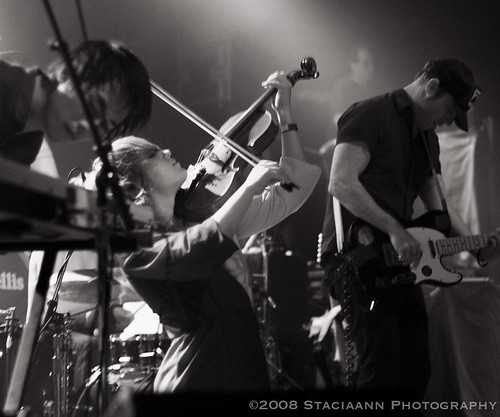
The Airborne Toxic Event are from Los Angeles, but not the L.A. everyone sees on TV. I sat down with lead singer Mikel Jollett and bassist Noah Harmon and they made that pretty clear. “Everyone thinks L.A. is Hollywood and that exists,” Jollett says, his speaking voice sounding much softer than his gravelly, Mike Ness-like onstage growl. “But L.A. is black, L.A. is Mexican, Laotian, Ethiopian,” he continues, “my high school had, like, nine white kids in it--it’s like growing up in Queens.” Harmon adds, “Everyone thinks L.A. is Beverly Hills/Paris Hilton shit, but it’s like, ‘Motherfucker, haven’t you seen Boyz N The Hood’?” Jollett continues, “Haven’t you seen Stand And Deliver? White people don’t know about L.A., they think it’s a whole other thing than what reality is.”

TATE came from seemingly nowhere, toting a cache of songs that remind one of The Smiths darkest places, the mid-tempo offerings of The Cure, slices of Modest Mouse, bits of Social Distortion, and one song that opens with the same lyrics as LCD Soundsystem’s “All My Friends.” In the wrong hands this would amount to an unmitigated disaster, but de facto leaders Jollett and Harmon are smarter than a lot of people that play in bands; smarter than a lot of people, period. They not only make it work, but make it sound cohesive and fresh to boot. Sound calculated? Hardly. It sounds almost accidental - accidental in that way that makes you say, “Wow, I didn’t think the song was going there,” several times while listening to the album. Steven Chen's guitar work can be as caustic as it can be precious, Daren Taylor sounds like he's beating on his drums with lead pipes at times, Anna Bulbrook almost single-handedly gives the album multidimensionality with her violin and synth work - to say nothing of Harmon and Jollett's formidable contributions on bass and rhythm guitar, respectively.


Read more after the jump

While taking up residency at Silver Lake hotspot Spaceland, their single, “Sometime Around Midnight” began getting radio play on L.A.’s Indie 103, among several other radio stations, which isn’t surprising given the caliber of the music save for one tiny detail: they weren’t signed to a label yet. When the industry came calling, they had the rare upper hand entering negotiations. “We signed the most artist-friendly record deal ever,” Jollett says. They retained control of their music as well as the rights to it. One A&R man from an unnamed major told them they wouldn’t get radio play without his label’s support, which seemed funny to them, as he was talking to them precisely because he had heard them on the radio already. It rarely, if ever, works like this. Bands often give up too much on the front end for a shot at fame, only to be left in the odd, disheartening position of being gold- or platinum-selling artists who are flat broke. “We made sure we were taken care of,” Jollett says of the deal they signed with Majordomo Records, which is run by members of fellow L.A. band Earlimart--it’s probably not a coincidence they got a stellar deal from an artist-run label.

Indeed, they’re no dummies. They come across as the exact opposite of the pre-conceived notions that many people have about guys who play in bands. They are articulate, well-read (their name is taken from a section of Don Delillo’s 1985 novel White Noise), and have other interests outside of playing music. Prior to fronting TATE, Jollett was a struggling writer on the cusp of success. He’s recently been published in McSweeney’s, the magazine started by literary wunderkind Dave Eggers, and has a novel in the works that he hopes to publish in four parts, then as a whole at a later date (he’s been working on it in the van while on tour, he says). The New Yorker showed interest in some of his work as well. “I was right at the moment of: ‘I have a literary agent for the novel, I got a piece in McSweeney’s, The New Yorker wants to see stuff.’ and then I said, ‘You know what? I’m going to start a band.’” It indicates an incessant need to create on Jollett’s part, if one avenue doesn’t work, he always has the other to travel down - but at the moment, both seem to be getting a lot of traffic.

To dispel any notion that the band is just a lark that turned into something more by accident, I ask them about the genesis of the band. Harmon was reluctant initially, but after listening some demos that Jollett sent him, he found them clever and joined up. Jollett jokes he had to beat Harmon into submission and that, contrary to popular belief, physical violence solves everything. We all laugh and I’m struck by how comfortable they are with their position as up-and-comers in an insanely competitive business in an insanely competitive city. “Tons of people play in (bands in) L.A.” Harmon offers, “but only a handful are really fucking serious about it. After we signed the deal, Mikel had a plan to tour the next day. Most bands are out getting drunk, we had pie charts and shit.” I think he’s joking, but the intensity and exuberance with which they approach and discuss the band, it’s entirely possible these charts exist somewhere.

The Airborne Toxic Event seems to have prepared for everything except failure, it seems, an unlikely happening at this point. A bit of nearly impossible luck has put them directly in charge of their own careers and destiny, a rarity in an industry filled with bloodsuckers, sharks, and peril seemingly around every corner. They managed to dodge the worst of it at the outset by inadvertently tipping the scales in their favor, now it’s just a matter of keeping them there.

Download The Airborne Toxic Event's performance on KCRW here.

More photos from the band's performance at First Avenue here.

Extra special thanks to guest columnist Pat O'Brien.